
2026-06-25 16:03:21
Wear Resistant Liquid Cooling Heat Dissipation Hose For Industrial Cooling Equipment
As rack power density keeps rising in modern computing infrastructure, air cooling can no longer stabilize the operating temperature of high-performance servers. Liquid cooling has gradually become the mainstream thermal management solution for large-scale computing facilities. As the key fluid transport component, coolant delivery hose directly determines the stability of the whole heat dissipation system. Four mainstream pipeline products including water cooling heat dissipation hose, data center liquid cooling hose and data center cooling hose are widely deployed in server cabinets, cold plate circulation loops and cooling unit connection pipelines.
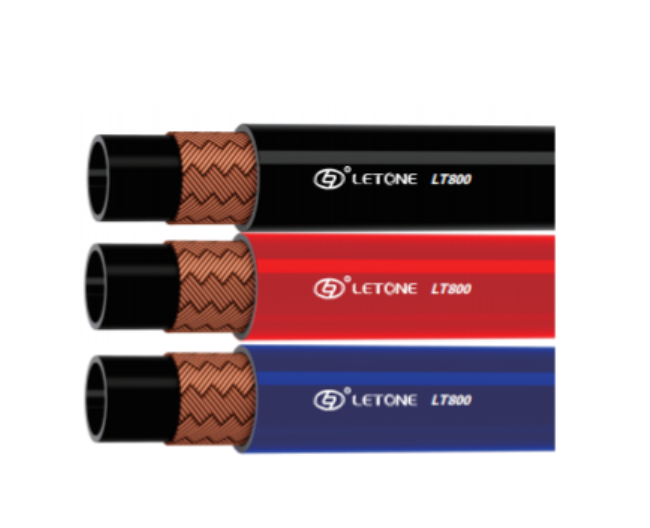
Coolant delivery hose is designed exclusively for circulating transmission of water-based antifreeze coolants. Unlike ordinary industrial rubber tubes, this type of hose focuses on low flow resistance, low permeability and long-term anti-aging performance. The inner wall is made of smooth polymer material to reduce fluid friction and avoid coolant residue and scaling. The middle braided reinforcement layer maintains stable structural shape under continuous working pressure and prevents expansion and deformation during long-term circulation. The outer protective layer resists indoor humidity, dust and slight mechanical extrusion, which greatly reduces hidden leakage risks inside compact server cabinets. Poor quality coolant delivery hose may suffer from liquid seepage, which would damage IT hardware and cause unexpected downtime of data center equipment.
Water cooling heat dissipation hose is the general category for all thermal circulation pipelines. Ordinary water cooling heat dissipation hose is used in conventional industrial equipment cooling loops, while upgraded versions are modified to adapt to data center operating conditions. The optimized water cooling heat dissipation hose features higher flexibility to fit narrow internal cabinet spaces. Installers can bend and arrange pipelines freely without flattening or blocking the coolant flow path. This structural advantage makes water cooling heat dissipation hose more suitable for dense wiring between cold plates, distribution manifolds and cooling water units, shortening the on-site pipeline layout cycle greatly.
Data center liquid cooling hose is the upgraded customized version developed for immersion cooling and cold plate liquid cooling systems. Compared with common water cooling heat dissipation hose, data center liquid cooling hose has stricter requirements on medium compatibility. It will not swell or degrade after long-term contact with glycol coolant, deionized water and other heat transfer media. The multi-layer composite structure effectively avoids water vapor penetration and prevents liquid leakage caused by pipeline aging. Most hyperscale computing parks select qualified data center liquid cooling hose to build closed circulation systems, ensuring continuous heat transfer for high-power computing hardware all year round.
Data center cooling hose covers all flexible pipelines used in data center thermal management systems, including air conditioning water pipelines and server liquid cooling pipelines. When selecting data center cooling hose for different projects, construction teams distinguish working conditions clearly. Conventional air-conditioning circulating water can adopt ordinary data center cooling hose to control construction cost. Server direct liquid cooling loops must adopt high-specification coolant delivery hose and data center liquid cooling hose to guarantee safety. All finished hoses pass pressure tightness test and anti-permeation test before delivery to meet long-term 24-hour continuous operation requirements.
With the popularization of high-density computing and AI server clusters, liquid cooling technology will be further promoted globally. The upgrading of coolant delivery hose, water cooling heat dissipation hose, data center liquid cooling hose and data center cooling hose will focus on thinner wall thickness, higher bending resistance and zero liquid permeability. Optimized liquid cooling hoses will provide reliable fluid delivery guarantee and help data centers achieve stable, low-failure heat dissipation operation.

Leave a Comment